
Flight time – a rare RAF pilot’s watch set to soar at auction
Flight time – a rare RAF pilot’s watch set to soar at auction
One of the “most important military watches in history” appears at a London auction this week <Nov 28> expected to make £4,500.
The Swiss-made Mark XI from the International Watch Company (IWC) was first strapped to pilots’ wrists in 1949, at the time the most accurate military wristwatch ever produced.
Issued to the British Royal Air Force (RAF) and Commonwealth air forces, the Mark XI was more than a watch, it was a complex navigational tool.
It was designed to meet the needs of Cold War navigators who depended on split-second accuracy on long-range flights, often in poor visibility.
Chris Kirkham, from Hansons Auctioneers’ London saleroom in Richmond where the watch goes under the hammer on November 28, said: “The IWC Mark XI was a purpose-built, ultra-reliable military pilot watch that ended up shaping what a pilot watch should look like – even today. Quite simply it is the most important military watches in history. It’s also rare, historically important and still cool in its simplicity.”
The Mark XI’s predecessor, the IWC Mark X, is famously part of the battle-hardened ‘Dirty Dozen’.
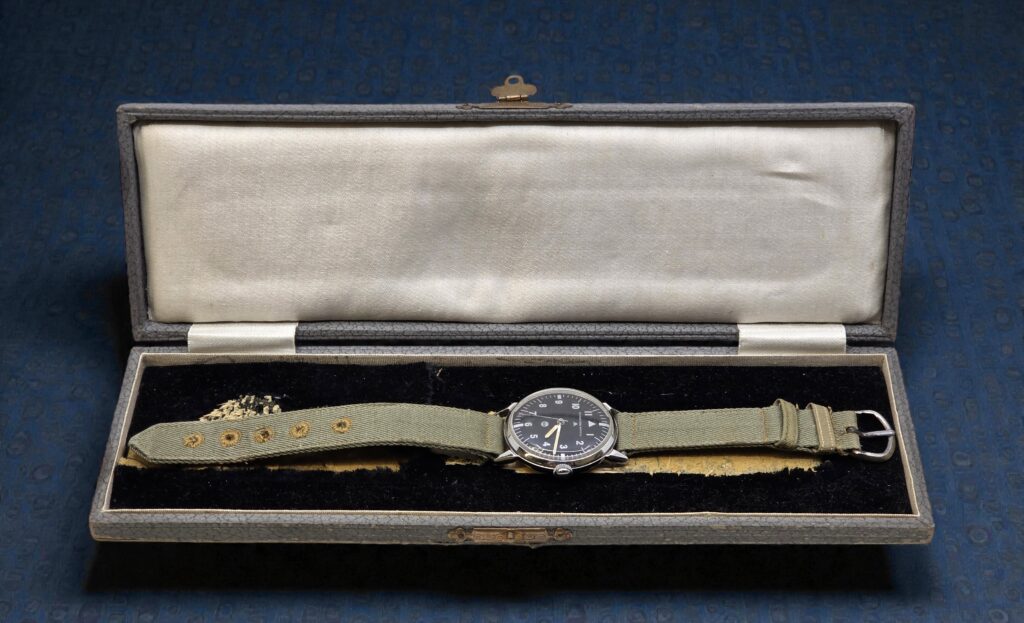
Loved by collectors, these12 watches were commissioned by the Ministry of Defence from Swiss maker in the latter part of WWII for army ground personnel in need of a reliable timepiece.
While watches supplied to the British Army could be somewhat basic, RAF-issued versions, needed for navigation or bomb aiming, needed to be state of the art.
Chris continued: “If the ‘Dirty Dozen’ Mark X was a workaday model, the Mark II, powered by the celebrated calibre 89, was a Rolls Royce.
“From the ‘50s the RAF bomber nuclear aircraft included radar equipment as standard. But because it had to be shut down in hostile airspace, to avoid detection, it was vital to have a navigator on board responsible for conventional navigation. Hence the Mark XI’s importance.”
The Mark XI had to meet the requirements of flights at an altitude of 26,000ft and speeds up to 500mph. Later this increased to up to 70,000ft and 650mph.
The watertight glass had to prevent humidity getting into the case and cause deviation of accuracy.
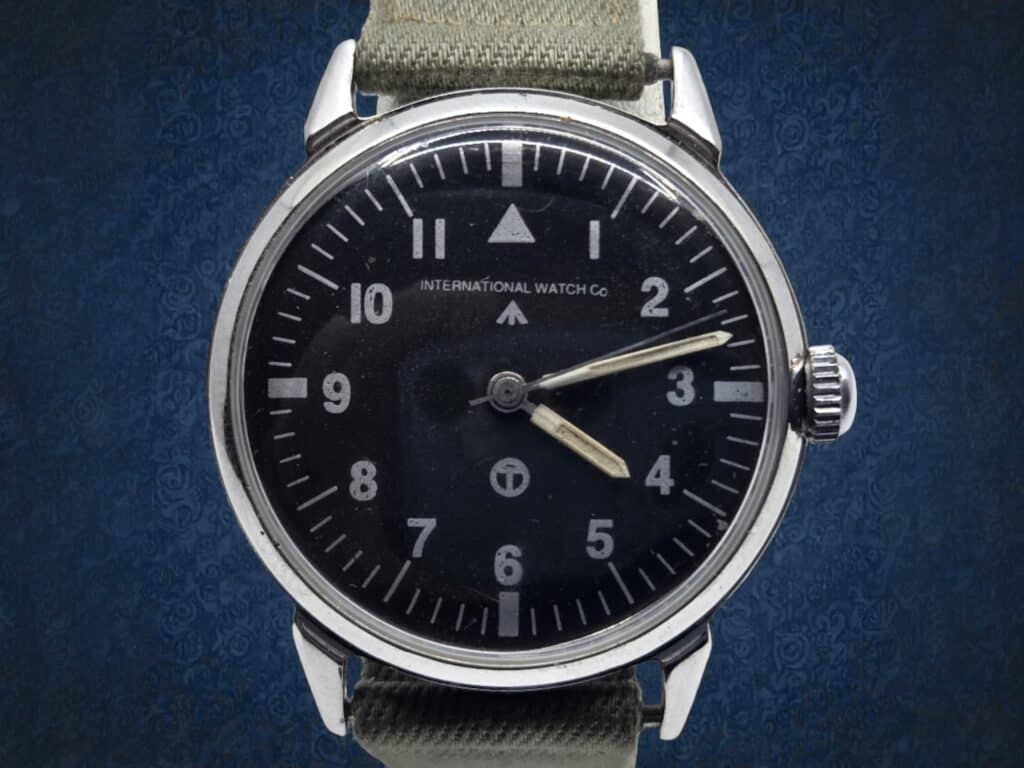
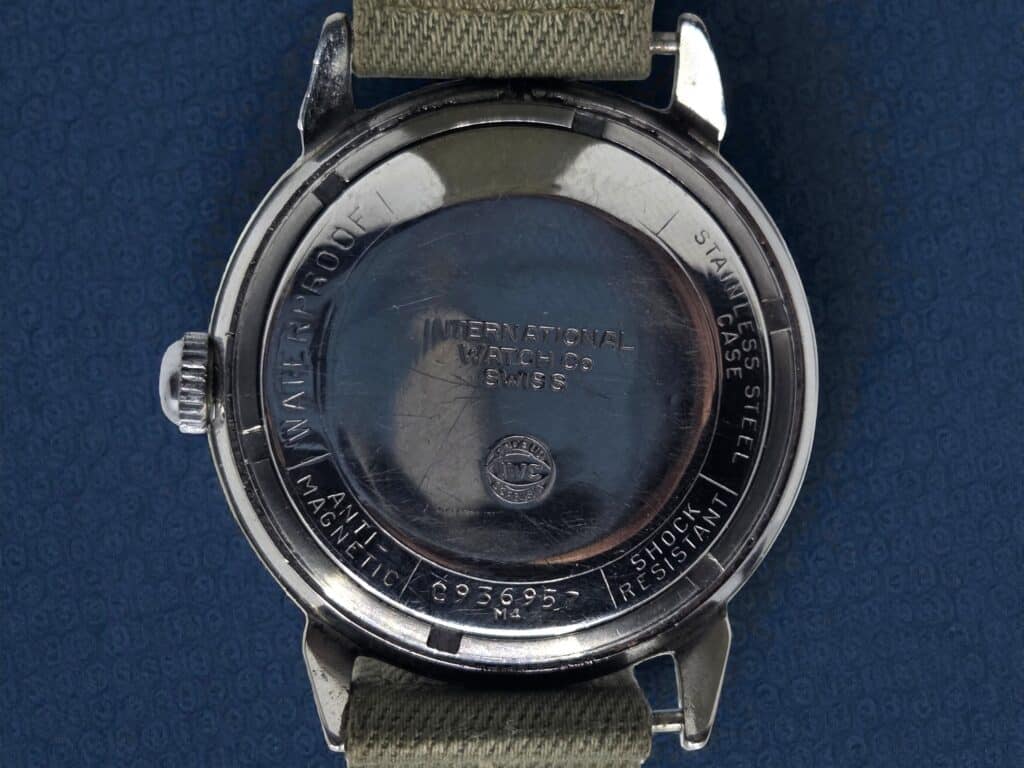
On its introduction in 1949, the numbers from 1 to 12 were written out with rectangles at 3, 6, 9 and 12 o’clock. In 1952, the number 12 was replaced by the characteristic triangle. The circled ‘T’ denotes tritium was used as the luminous material on the dial rather than the less-safe radium.
As well as being used by other Commonwealth countries such as South Africa, Australia and New Zealand, the Mark XI was used on a trip to the South Pole in 1958 by New Zealander Sir Edmund Hillary – the first person to conquer Mount Everest.
The Mark XI was retired in 1984 after a creditable 36 years.
In the later stages of its production run, as military contracts ran out, the IWC released a civilian iteration to meet growing demand for the ultra-cool design.
Approximately 1,000 civilian watches were sold between 1973 and 1983, each with a seven-digit case number stamped on the back.
Chris continued: “For watch aficionados today, seeking out an IWC Mark XI is nothing short of a mission objective. For some, it is the rugged, pared back aesthetic that they love. For others, it is the personal histories behind these watches that appeals. Either way we know military watches are loved and greatly sought after.”
Auction Details
Auction: London November Jewellery & Gifts Auction
Auction date: 28th November 2025 | 9:30am
Location: Hansons London Saleroom
Auction contact: service@hansonsauctioneers.co.uk
Catalogue/bidding: www.hansonslive.co.uk | www.the-saleroom.com